
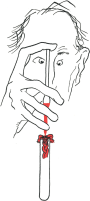
Leo Vroman
Leo Vroman (1915–2014) was a poet, biologist and artist, one of the most multifaceted creatives of his time. He referred to himself as a ‘science guy’, but his poetry, his art and his personal life with his beloved Tineke and their daughters Peggy and Geri were just as important to him. He fled the Netherlands at the beginning of WWII and eventually settled in America. He became well known there as a scientist but at home his poetry was famous, which was published by Querido from 1947.
“Come tonight with that refrain
from Peace, Sleepwalking, 1957
about the ending of the war,
sing it a hundred times and more:
and every time I’ll cry again”
These famous lines from the poem ‘Peace’ were written by Leo Vroman (1915–2014). One of the most important and multifaceted Dutch poets.
Vroman was not only a poet, he was also a biologist, artist, Jewish, opinionated, curious, funny. His work is universally playful and imaginative, he wrote just as happily about death as he did of the profound love he felt for his wife Tineke. His poetry is fearless: he ignores all the conventions and embraces beauty as much as ugliness.
He was awarded many literary prizes, from the Lucy B. and C.W. van der Hoogt prize for his collection ‘Poems, early and later’ (1949) to the P.C. Hooft prize in 1964 and in 1996 the VSB Poetry prize for ‘Psalms and other poems’. In 1989 he received an honorary doctorate from the University of Groningen. He wrote prose as well as poetry (de adem van Mars, Snippers, Het Carnarium), theatrical pieces, diaries and other autobiographical works (Warm, red, wet and sweet; Blood), he also made drawings and illustrations.
“I despite everything love this world
from: About Poetry, Two Poems, 1961
for its tenuous borders
over which I carefully tread;
That’s why my faith is universal,
I love to be, for a few seconds,
a Jew to
hear a joke and I am actually
quite catholic in churches
although not always the right ones
(I don’t notice small differences)”
His work is written primarily from his own perspective and about himself. About his past and his world view. About the green field in Gouda during his adolescence, about Tineke’s ‘hidden’ breathing and how much he missed her during the war. His fascination with the blood he examined on microscope slides, mathematical series, intestines, his daughters’ rooms, his reaction to current events: earthquakes, rapes, murder and violence. About his ageing limbs, his organs, his caressing fingers, his curiosity about death. He wrote his poem “End” a few days before he died.
********** Follow us on Facebook for news and developments *************